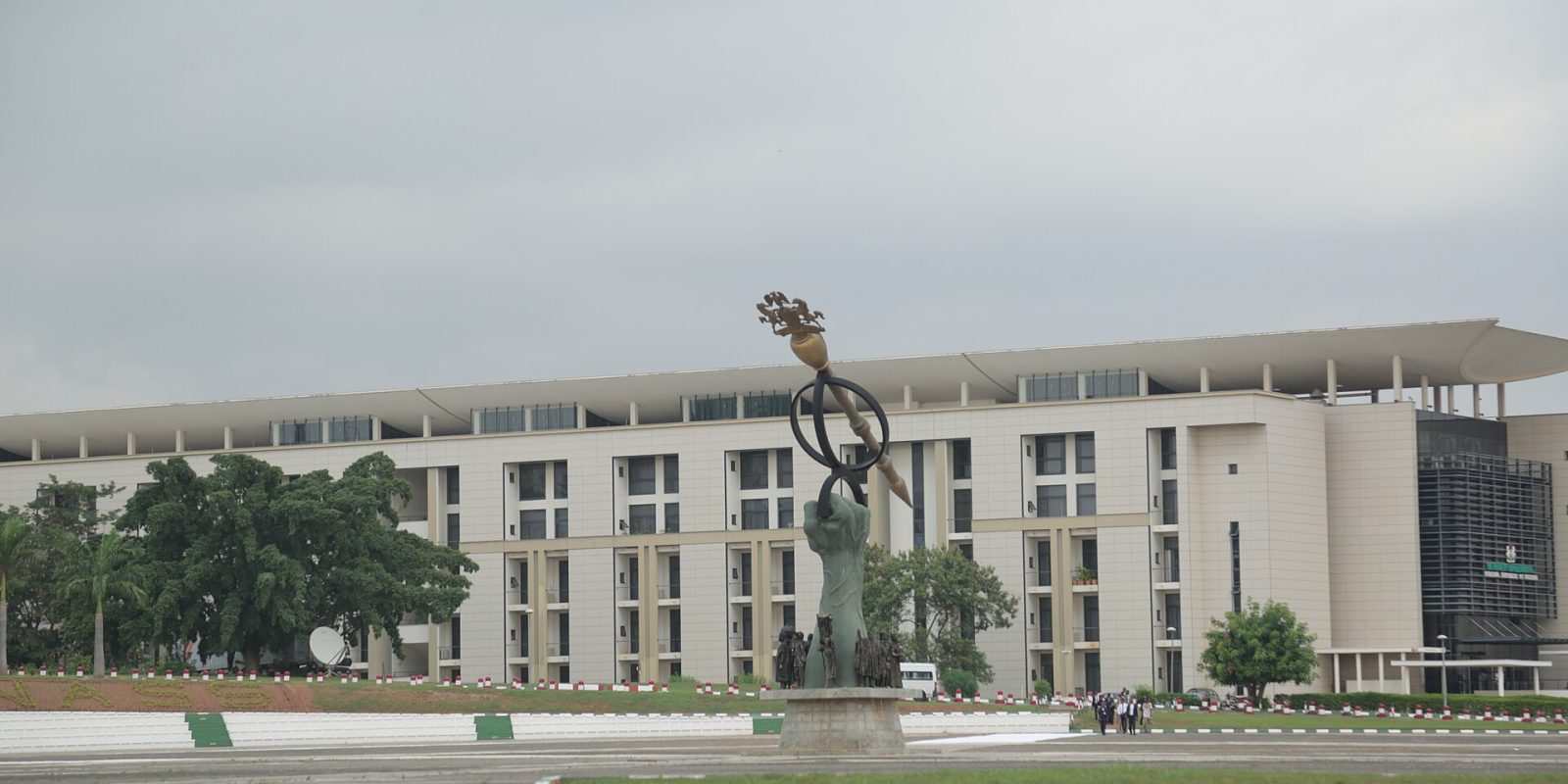
The National Assembly Complex, Abuja. Photograph: Wikimedia Commons.
Democratic Era (1999–Present)
Since 29 May 1999, Nigeria has been governed by elected civilians — the longest unbroken run of democratic rule in the country’s history. The Fourth Republic has survived contested elections, an insurgency, economic crises and a pandemic, and has seen power change hands at the ballot box.
Presidential Administrations
Olusegun Obasanjo (1999–2007) inherited a country in debt and isolation. His government won a landmark debt-relief deal in 2005, liberalised telecommunications — bringing GSM mobile phones to millions of Nigerians — and launched reforms in banking and pensions.
Umaru Musa Yar’Adua (2007–2010) offered an amnesty to militants in the Niger Delta in 2009, which calmed the region’s oil-producing creeks. He died in office in May 2010, and Vice-President Goodluck Jonathan succeeded him. Jonathan’s government rebased the economy in 2014, making Nigeria officially Africa’s largest economy, but faced the growing Boko Haram insurgency in the north-east.
Muhammadu Buhari (2015–2023) won office promising to fight corruption and insecurity, and oversaw major infrastructure projects, including the Lagos–Ibadan railway. Bola Ahmed Tinubu, elected in 2023, moved quickly on economic reform — removing the long-standing fuel subsidy and unifying the exchange rate.
Major Elections
Nigeria has held general elections in 2003, 2007, 2011, 2015, 2019 and 2023. The 2007 election was widely criticised, but electoral reform and the introduction of permanent voter cards and card readers improved later contests. The election of 2015 was a watershed: for the first time, an incumbent president lost, and Goodluck Jonathan’s graceful concession set a new standard for Nigerian democracy. The 2023 election was the most competitive yet, with three leading candidates and a record number of young voters.
Economic & Social Developments
Oil remains the backbone of government revenue. First discovered in commercial quantities at Oloibiri in 1956, petroleum made Nigeria a member of OPEC in 1971 and paid for much of the country’s development — but also for the pollution and conflict of the Niger Delta, and for a dependence on imports that later governments have tried to reduce.
The tech boom is the great new story. Lagos — nicknamed “Yabacon Valley” after the Yaba district where many start-ups cluster — is now the leading technology hub in Africa. Nigerian fintech companies such as Paystack, acquired by the American firm Stripe in 2020, and Flutterwave serve millions of users across the continent, and Nigerian founders have built companies in payments, logistics and e-commerce.
Nollywood, the Nigerian film industry, grew out of the home-video boom that began with Living in Bondage in 1992. Today it is one of the largest film industries in the world by output, and its stars and stories now reach global audiences through cinemas and streaming platforms.