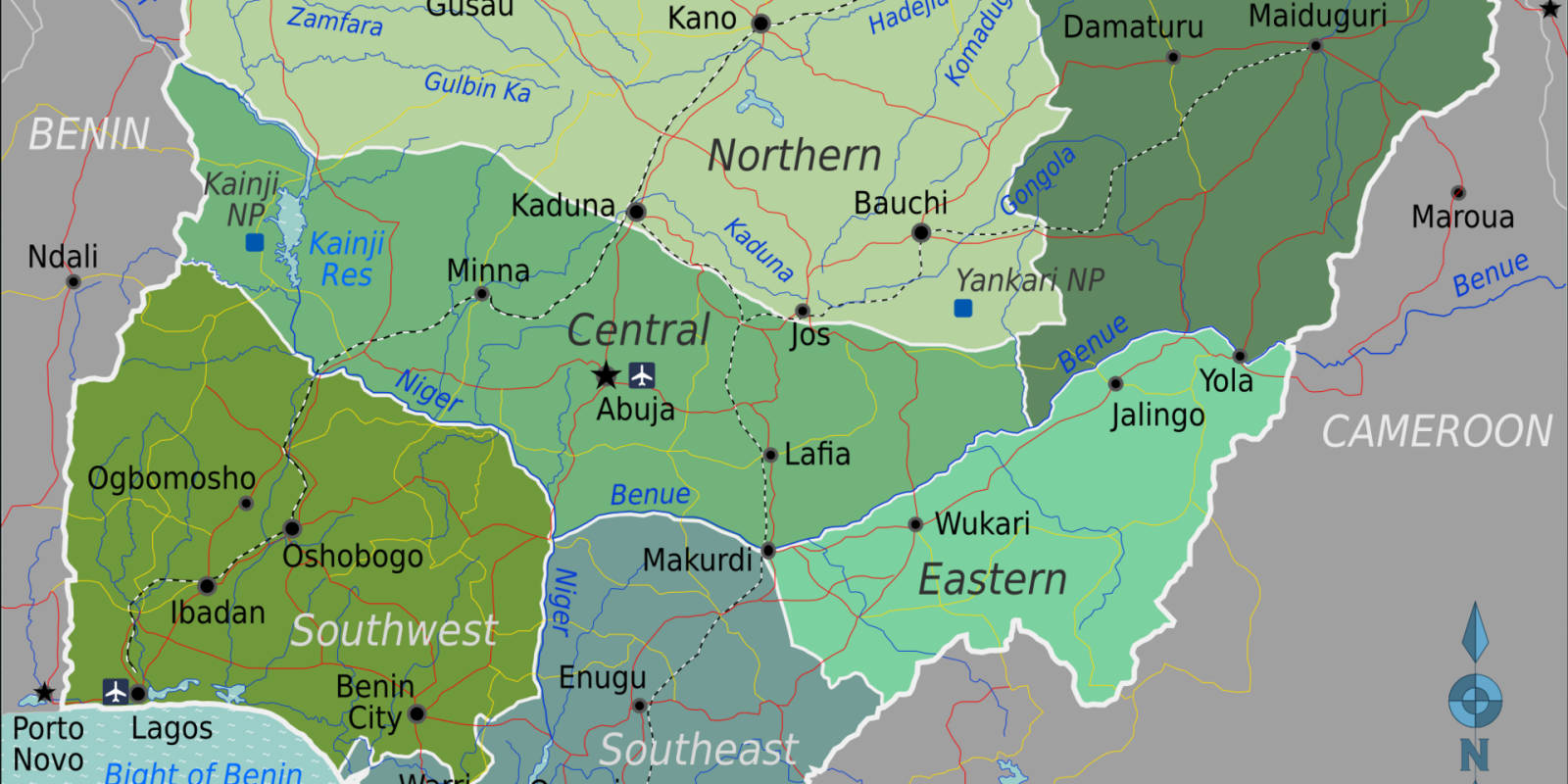
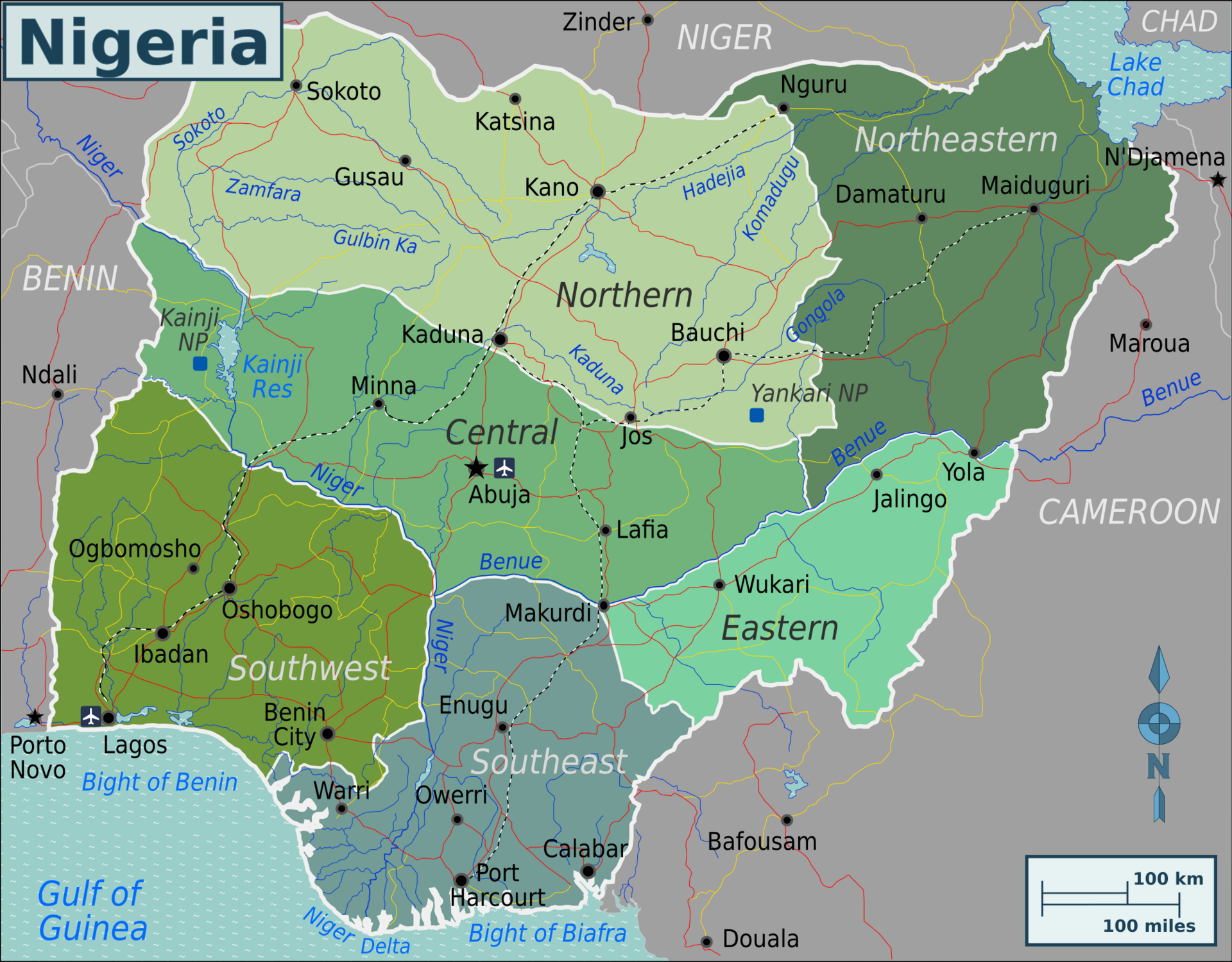
Map of Nigeria. Image: Wikimedia Commons.
Coups & Military Rule (1966–1999)
Between 1966 and 1999, Nigeria was ruled by soldiers for all but four years. The period opened with two coups in a single year, passed through a devastating civil war, and ended with a negotiated return to democracy in 1999.
The 1966 Coups
On 15 January 1966, a group of young army majors led by Chukwuma Kaduna Nzeogwu seized power, killing Prime Minister Balewa, Premier Ahmadu Bello and other senior figures. The army’s commander, Major-General Aguiyi-Ironsi, took control — but his government lasted only six months. In July 1966 a counter-coup by northern officers killed Ironsi, and Lt. Col. Yakubu Gowon became head of state.
The coups unleashed violence against Igbo people living in the north, and tens of thousands fled east. Trust between the regions collapsed. In May 1967 Gowon created twelve states, breaking up the old regions; days later, the military governor of the Eastern Region, Lt. Col. Odumegwu Ojukwu, declared the secession of the Republic of Biafra.
The Nigerian Civil War (1967–1970)
The war began in July 1967 and lasted thirty months. Federal forces, better equipped and backed by Britain and the Soviet Union, gradually encircled Biafra; Biafra, supported by France, Portugal and others, held out with extraordinary determination. The federal blockade caused a famine in Biafra that shocked the world — images of starving children filled television screens in Europe and America, and the war became one of the first humanitarian crises of the television age.
When Biafra surrendered in January 1970, Gowon proclaimed “no victor, no vanquished” and launched a programme of Reconstruction, Rehabilitation and Reconciliation. The war had cost well over a million lives, most of them civilians, and its wounds — over the conduct of the war, the famine, and the treatment of the Igbo afterwards — remain part of Nigerian public life today.
Subsequent Regimes
General Gowon (1966–1975) presided over the oil boom of the 1970s, when rising petroleum prices filled the treasury, and hosted FESTAC 77, the great pan-African arts festival in Lagos. He was overthrown in 1975 by General Murtala Mohammed, who began a rapid reform programme before being assassinated in a failed coup in February 1976.
General Olusegun Obasanjo (1976–1979) completed Murtala’s transition plan and handed power to the elected government of Shehu Shagari in 1979 — the first time a Nigerian military ruler had voluntarily surrendered power. The Second Republic lasted four years before the army returned under General Muhammadu Buhari (1983–1985), who was himself overthrown by General Ibrahim Babangida (1985–1993).
Babangida’s rule is remembered above all for the annulment of the presidential election of 12 June 1993, widely judged the freest in Nigerian history, which the businessman MKO Abiola was poised to win. The crisis that followed brought General Sani Abacha (1993–1998) to power — a period of harsh repression, including the execution of the writer and activist Ken Saro-Wiwa and eight other Ogoni leaders in 1995. Abacha died suddenly in June 1998.
Transition to Democracy
Abacha’s successor, General Abdulsalami Abubakar, moved quickly to hand over power. A new constitution was adopted, political parties were registered, and elections were held in early 1999. On 29 May 1999, Olusegun Obasanjo was sworn in as the first civilian president of the Fourth Republic — ending thirty-three years in which soldiers had ruled Nigeria for all but four of them.