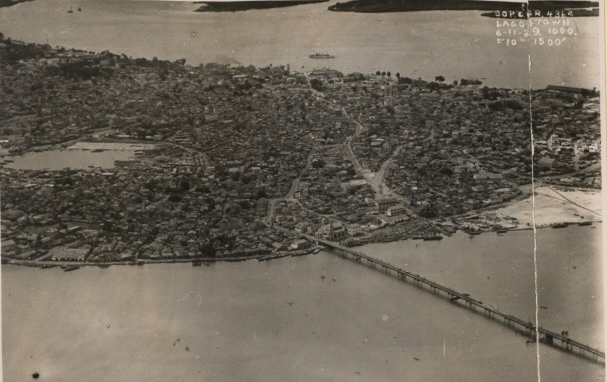
Lagos in 1929. Photograph: Wikimedia Commons.
Colonial Era (1861–1960)
For a hundred years, from the annexation of Lagos in 1861 to independence in 1960, the territory that became Nigeria was ruled from London. The colonial era brought railways and schools, but also taxation without representation, and a country drawn on a map rather than grown from its peoples.
British Annexation & Protectorates
In 1861, after bombarding the city, Britain annexed Lagos and made it a Crown Colony. From there, British power spread inland: the Oil Rivers Protectorate on the coast became the Niger Coast Protectorate, and in 1900 the Royal Niger Company’s territories were taken over as the Protectorate of Northern Nigeria.
In 1906 Lagos was merged with the Protectorate of Southern Nigeria. Then, on 1 January 1914, Governor-General Lord Lugard amalgamated the Northern and Southern Protectorates into a single Colony and Protectorate of Nigeria — joining peoples who had never before been one country. Lugard governed the north through indirect rule, leaving the emirs and chiefs in place under British supervision; in the south, where such rulers were fewer, the system fitted less well and caused lasting friction.
Missionary Influence
Christian missionaries arrived from the 1840s — the Church Missionary Society at Badagry and Abeokuta, and later Roman Catholic and other missions. They built schools and clinics, taught literacy in English, and converted many in the south. Education became the road to the new professions: King’s College, Lagos, opened in 1909; Yaba Higher College followed in 1934; and University College, Ibadan, was founded in 1948.
Islam, meanwhile, was already long established in the north, where the Sokoto Caliphate and the emirates ran their own schools and courts. The result was a country of two educational worlds — a divide that shaped Nigerian politics for generations.
Resistance Movements
Resistance to colonial rule never stopped. The Ekumeku movement in the west fought the British into the early 1900s. In 1929, thousands of Igbo and Ibibio women rose in the Aba Women’s War against taxation and the warrant chiefs — one of the most significant acts of resistance to British rule in West Africa.
By the 1930s a new generation of nationalists was taking the fight into print and politics. Herbert Macaulay founded the Nigerian National Democratic Party in 1923. Nnamdi Azikiwe, returning from study in the United States, launched the West African Pilot newspaper in 1937 and became the voice of a new, assertive nationalism. Obafemi Awolowo and Ahmadu Bello built their own movements in the west and north. Through the Nigerian Youth Movement, the NCNC, the Action Group and the Northern People’s Congress, and through the constitutional conferences of the 1950s, they pressed for self-government — first in the regions, then for the whole federation.